
Tyler County Parole vs Probation
Parole and probation both impose rules in the community, but they arise from different legal paths. The Texas Board of Pardons and Paroles makes state release decisions, and the TDCJ Parole Division supervises people released on parole or mandatory supervision. Tyler County Adult Probation handles court-ordered community supervision in local cases. Calling both systems “probation” can send a records request to the wrong office.
| Question | Parole or mandatory supervision | Probation or community supervision |
|---|---|---|
| How it begins | Release from TDCJ custody under a Board decision or mandatory-supervision process | A court places the person on community supervision as part of the case disposition |
| Who supervises | TDCJ Parole Division | Tyler County Adult Probation |
| Best first record | TDCJ offender detail, parole-review information, or TDCJ IVSS | Judgment and community-supervision order from the proper Tyler County clerk |
| Proof it ended | TDCJ discharge or supervision record | Court termination, discharge, or revocation order |
Verify Tyler County Post-Release Supervision
Begin with the event that placed the person in the community. A bond entry means release from jail but does not itself create parole or probation. A judgment placing someone on community supervision points to the county court file. A TDCJ parole decision and completed prison release point to state records.
- Identify whether the person left Tyler County Jail, a TDCJ prison such as Gib Lewis Unit, or another custody system.
- For a state prisoner, search the TDCJ Inmate Search using a TDCJ number, SID number, or an exact last name with the required identifiers.
- Read parole-review information as a decision or review status, not proof that release has happened.
- Use TDCJ IVSS for state prison, parole, mandatory-supervision, release, or discharge notifications.
- For local probation, obtain the judgment and community-supervision order from the County Clerk for a misdemeanor or District Clerk for a felony.
- Confirm the assigned office and request the later discharge, termination, warrant, or revocation record when current status matters.
Note: A current-custody locator is not a durable history after the person leaves that system.
Tyler County Supervision Offices Differ
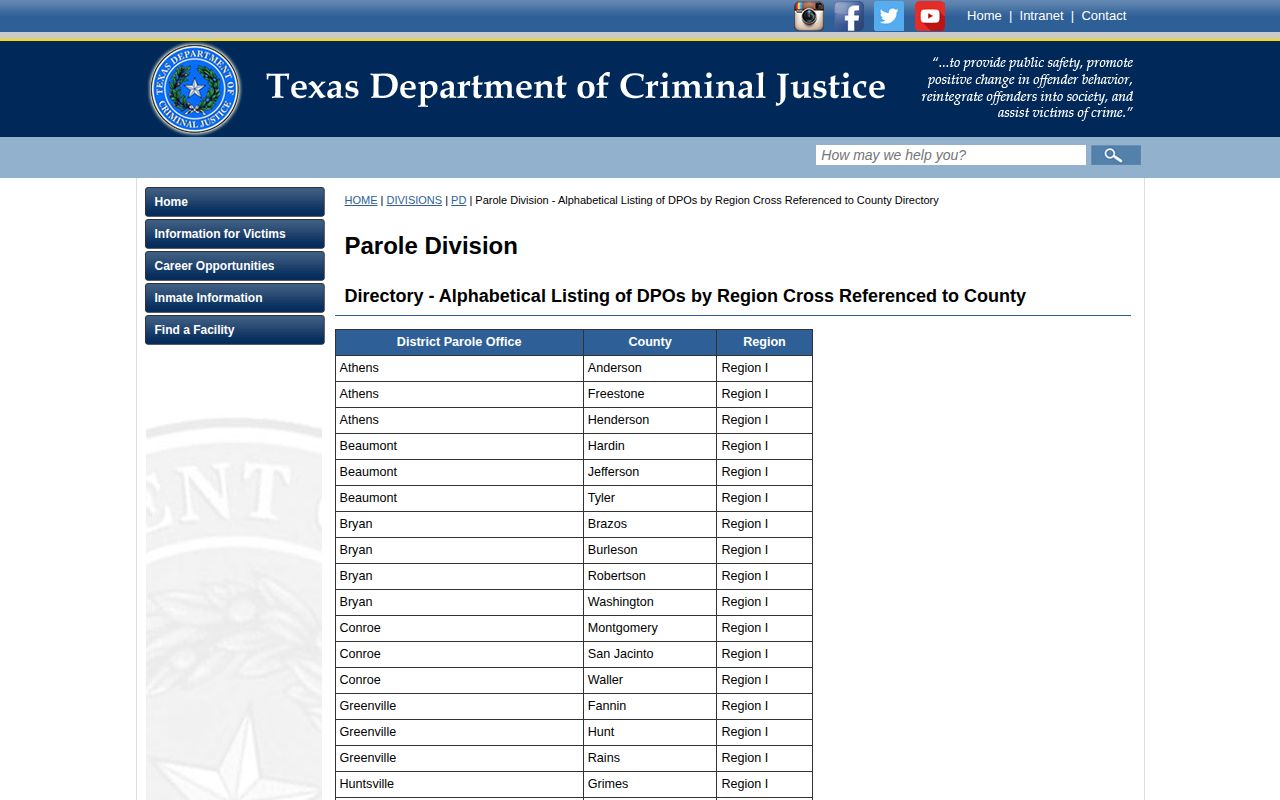
The local name creates a trap. TDCJ’s county cross-reference assigns people living in Tyler County to Beaumont DPO in Region I, not to Tyler DPO. By contrast, Tyler County Adult Probation is a Woodville county office. The person’s residence, sentence, and supervision type control the route, not the fact that the case or prison has “Tyler” in its name.
County probation contact
Tyler County Adult Probation
Christopher B. Thomas, Director
203 N. Charlton
Woodville, TX 75979
409-283-5255
The official TDCJ directory is the source for the state parole assignment. The captured TDCJ county-to-DPO cross-reference shows why a Tyler County parole inquiry belongs with Beaumont DPO.
Tyler County Parole Review Records
Texas parole review usually occurs through a three-member panel’s file review, not through a public Tyler County courtroom calendar. TDCJ identifies an initial case about six months before eligibility and a later case about four months before review. An Institutional Parole Officer interviews the prisoner and prepares a summary. Votes proceed in sequence, and two matching votes ordinarily settle the result.
Before a vote, the Board status line is 844-512-0461. A result code needs to be read precisely. FI and its program-conditioned variants are approval outcomes; NR denies release and gives a later review month and year; SA means serve all; DMS concerns denial of mandatory supervision. CU/NR and CU/SA apply in certain consecutive-sentence cases. None of these codes alone proves the person has walked out of a unit.
Tyler County Parole Release Processing
After a favorable vote, Review and Release Processing issues the release certificate when conditions are met, and TDCJ Records calculates the scheduled date. TDCJ describes an ordinary overall process of about four to six weeks and a date calculation that may take 14 to 21 business days after certificate receipt. Those are estimates, not a promise for one Tyler County case.
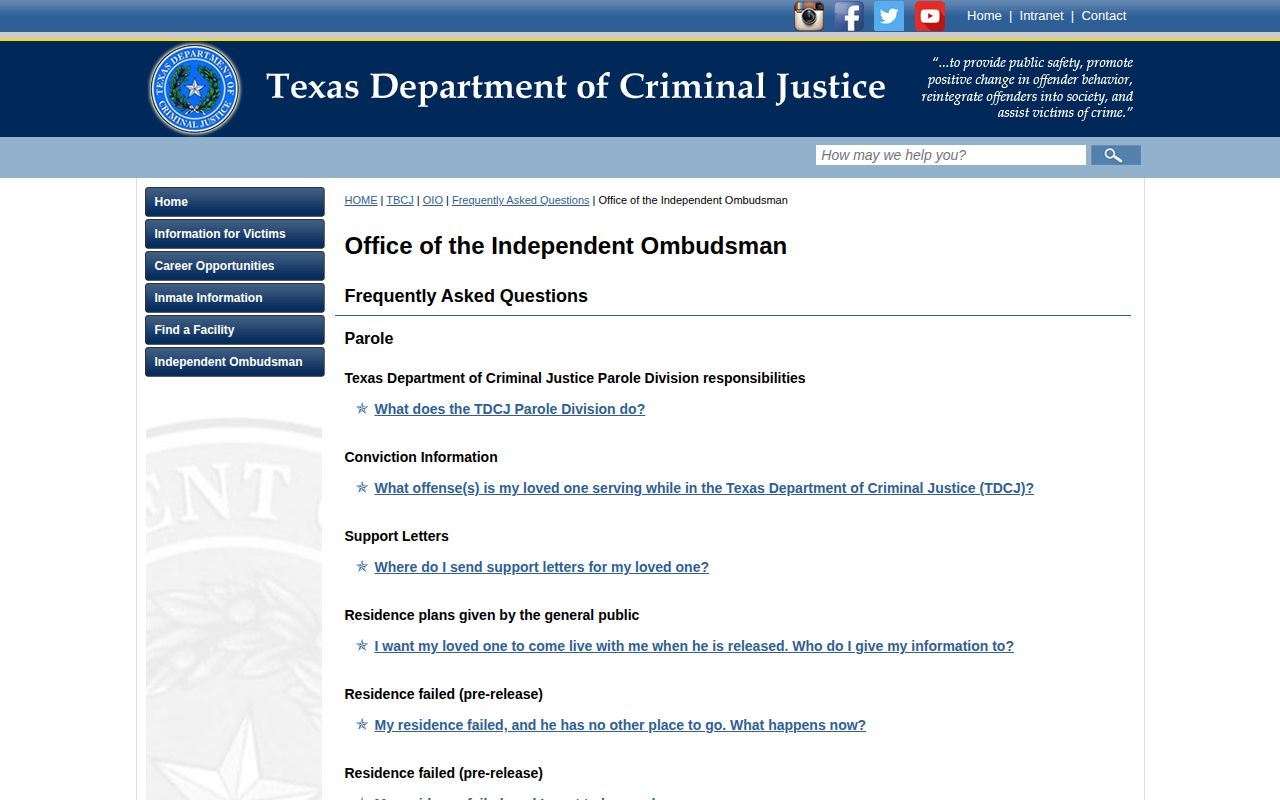
The official TDCJ release-processing guidance explains that a scheduled date and location remain subject to change.
After a favorable vote, the Parole Division release-status line is 512-406-5202. Supply the TDCJ or SID number, or the exact date of birth. For a full explanation of projections, see the Tyler County inmate release date guide.
Tyler County Supervision Conditions and Warrants
Conditions are individual. They may govern reporting, residence, travel, treatment, contact, or other conduct in the signed supervision documents. A general web page cannot establish which terms apply to one person. The controlling sources are the parole certificate and TDCJ supervision record for parole, or the court’s community-supervision order for probation.
Check effective dates as well as the terms. An order may be amended, extended, ended early, or replaced after a violation proceeding. The first order may not describe the current status, so ask for later modifications and the final disposition when a complete record is needed.
A new arrest, motion to revoke, warrant, or “blue warrant” can change the status. District Clerk motion-to-revoke dockets are schedules, not proof that a warrant was served or that custody changed. Likewise, an IVSS alert can identify a custody event but does not explain the complete supervision case. Verify a warrant through the issuing authority and verify detention through the agency that now has custody.
Note: “Was paroled” describes a past event and does not establish that the person remains in the community today.
Gib Lewis Pre-Release Programs
Gib Lewis Unit is a state prison in Tyler County, not a county probation office. Its official program list includes CHANGES/Pre-Release and Reentry Planning. Those programs provide a local, facility-specific preparation route within TDCJ. They should not be presented as benefits guaranteed to every person leaving the unit.
Participation also does not prove release, parole approval, or discharge. A person may complete programming and remain in custody, transfer to another TDCJ unit, or await final processing. Use the program listing only to understand preparation available at Lewis, then use TDCJ status, IVSS, and the completed release record for the actual custody result.
When Tyler County Supervision Ends
Physical release and legal discharge are separate milestones. A person can leave prison and remain under parole conditions until the supervision term ends. A probationer can finish the active reporting phase yet still need a court order or official record showing termination. Do not infer discharge from the absence of a recent jail booking or an old social post.
For state supervision, request public incarceration and supervision history through TDCJ’s Public Information Act channels. Useful fields include release type and date, discharge or maximum-expiration date, and release location if public. TDCJ Classification and Records can address time calculations at 936-437-6231 or classify@tdcj.texas.gov. For probation, ask the appropriate Tyler County clerk for the judgment, initial supervision order, amendments, and the later termination, discharge, or revocation order.
Texas Government Code Chapter 552 governs public-information requests and exceptions. Privacy, active law-enforcement matters, juvenile rules, sealed records, and expunction may limit production. The broader Tyler County released inmate search and records guide explains how the custody release entry and court disposition fit together.