
Four Tyler County Release Dates
Four dates answer four different questions. A parole eligibility date is when the Board may consider a case under the governing statute. It is not an approval. The Projected Release Date, or PRD, is TDCJ Classification and Records’ conditional estimate for leaving incarceration if parole does not occur sooner. A scheduled date appears later, after a favorable decision and release processing. The actual release or discharge date records the completed event.
| Date | What it means | What it does not prove |
|---|---|---|
| Parole eligibility | Review may occur under the applicable law | Approval or release |
| Projected release | Conditional TDCJ calculation | A fixed exit day |
| Scheduled release | Later processing has assigned a proposed day and location | That all holds and steps are cleared |
| Actual release or discharge | Custody departure occurred | That all supervision ended, unless the record says discharge |
Find a Tyler County Projected Release Date
The route turns on where the person is held and why. TDCJ operates Gib Lewis Unit in Woodville, but Tyler County Jail is a separate Sheriff facility. A state-prison calculation does not govern a county misdemeanor sentence.
- Identify the holding authority: Tyler County Jail, TDCJ, federal custody, immigration custody, or another county.
- For a current TDCJ prisoner, use the TDCJ Inmate Search. It accepts a TDCJ number, SID number, or an exact last name with the required name fields.
- Read “Projected Release Date,” “Parole Review Information,” and any later “Scheduled Release date” or “Scheduled Release location” as distinct fields.
- If the person is in Tyler County Jail awaiting trial, check the bond and court order. There may be no fixed date to calculate.
- For a local sentence, obtain the judgment, sentence, and jail-credit notation, then ask Corrections about the particular calculation.
- For history, request the Sheriff release entry or TDCJ incarceration and discharge record. Do not rely on the person disappearing from a live search.
Note: TDCJ says its public search covers current prisoners, updates on working days, and is at least one day old.
TDCJ Tyler County Release Fields
A TDCJ detail may show location, conviction information, projected release, parole review, and later scheduled fields. It is a prospective current-custody tool rather than a historical discharge certificate. A person transferred from Lewis to another TDCJ unit remains in state custody even though the local unit changes.
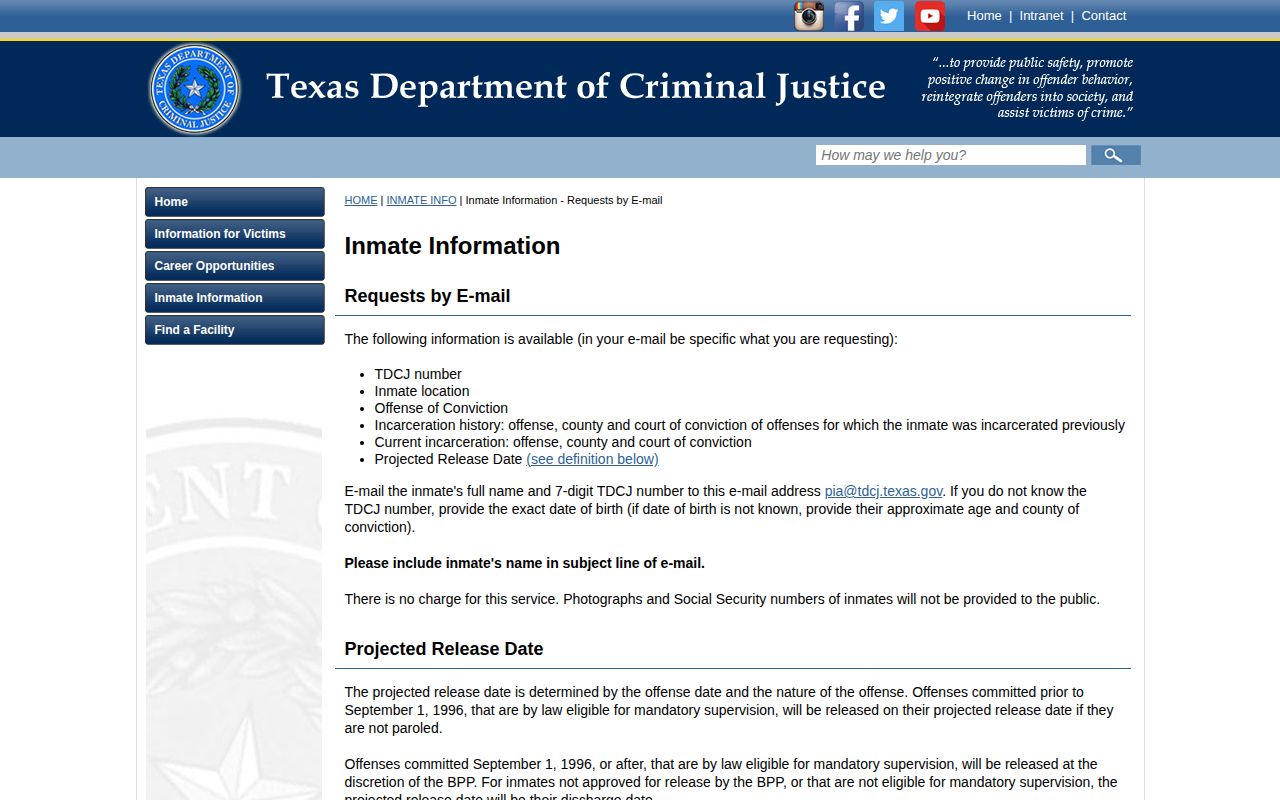
TDCJ also offers a no-charge inmate-information email route. With strong identifiers, it can return the TDCJ number, location, offense of conviction, incarceration history, current incarceration, and PRD. The official TDCJ email information page explains the fields and identifier requirements.
Texas Good Time and Tyler County Dates
Texas Government Code §498.003 governs TDCJ good-conduct time. It calls good time a privilege, not a right, and applies it to parole or mandatory-supervision eligibility rather than reducing the court’s sentence itself. Subject to law and TDCJ rules, classifications can include 20 days of credit for each 30 days actually served in trusty or Class I status, with possible extra trusty credit; 10 days per 30 in Class II; and none in Class III.
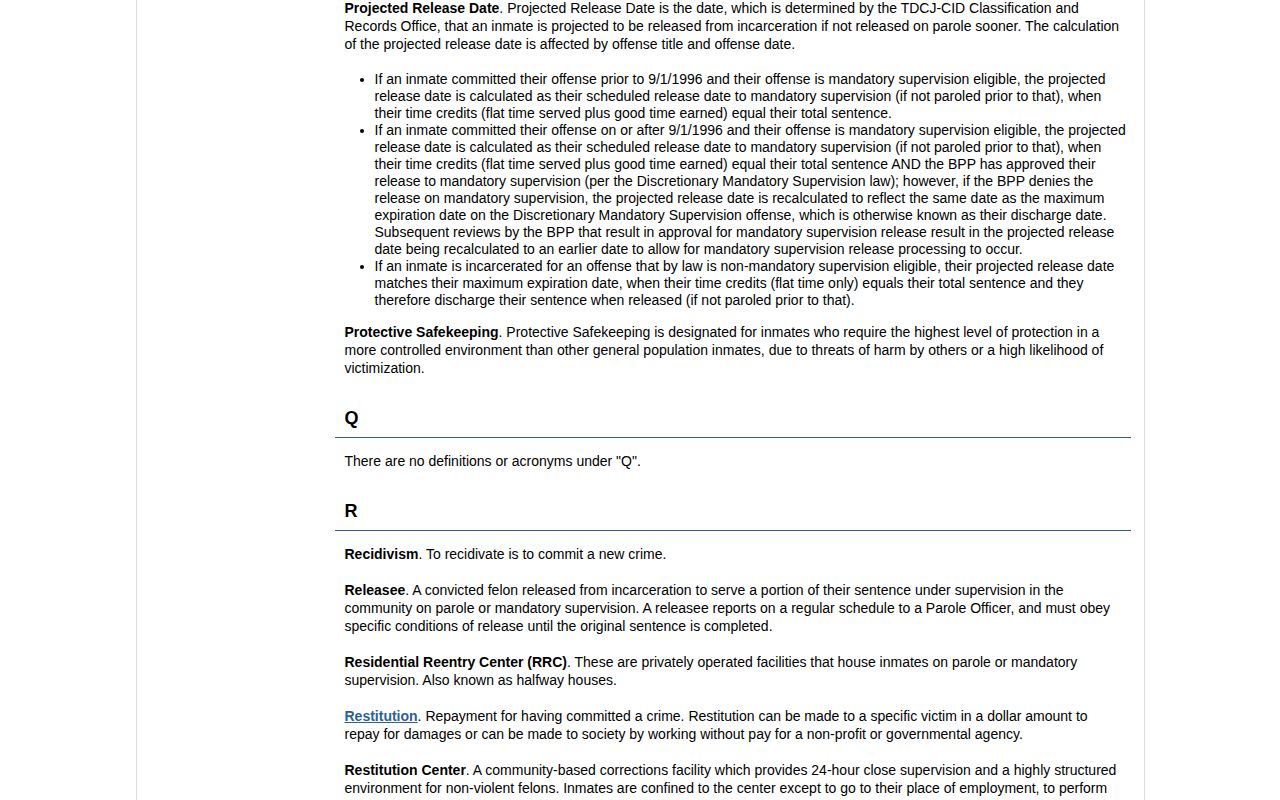
Those figures are not a safe release-date calculator. Classification can change. Credit can be earned, forfeited, or restored. Offense date, statutory exclusions, the judgment, sentence credit, and the treatment of concurrent or consecutive terms all matter. The TDCJ projected-release definition provides the official framework used for the calculation.
No Tyler County 85 Percent Formula
Texas does not impose one blanket rule requiring every state prisoner to serve 85 percent. That phrase is often tied to federal truth-in-sentencing grant criteria, not a universal Texas calculation. Using it for an individual Tyler County or Gib Lewis case can produce a false date.
Government Code §508.145(d) commonly requires actual calendar time equal to one-half of the sentence or 30 calendar years, whichever is less, for listed serious offenses and certain deadly-weapon judgments, subject to statutory minima and case-specific rules. For many other cases, §508.145(f) uses actual time plus good time equaling one-fourth of the sentence or 15 years, whichever is less, again subject to other subsections and offense dates. Code of Criminal Procedure art. 42A.054 contains the current serious-offense and deadly-weapon framework formerly called “3g.” TDCJ Records must perform the individual calculation.
Mandatory supervision adds another layer. Sections 508.147 and 508.149 distinguish eligibility and exclusions. For eligible offenses before September 1, 1996, flat time plus good time can determine a release point. For eligible offenses on or after that date, release is discretionary, and the Board may deny it under the statutory findings. A denial can move the projection toward maximum expiration.
What Changes Tyler County Release Dates
A date can move before or after a favorable parole decision. The cause should be confirmed with the office that controls that part of the file.
| Factor | Possible effect | Best record |
|---|---|---|
| Good-time status | Earning, forfeiture, restoration, or classification changes the calculation | TDCJ time-calculation record |
| Sentence data | New jail credit, correction, or concurrent/consecutive treatment changes inputs | Judgment and TDCJ Records audit |
| Mandatory-supervision review | Board action can delay release | Parole Review Information and decision record |
| Parole decision | Approval, denial, or program condition changes the path | Board vote code and certificate status |
| Detainer or court action | Another authority can block community release or change destination | Warrant, detainer, or court order |
| Release processing | Residence approval, programming, audit, transport, or certificate work can move a scheduled day | TDCJ release-processing status |
Tyler County Jail Date Limits
A pretrial detainee’s departure depends on bond, a court order, dismissal, acquittal, transfer, or another event rather than a prison-style PRD. The Tyler County Sheriff publishes no local good-time policy, weekend-release rule, gate hour, or jail-made date algorithm. Those gaps should not be filled with practice from another Texas county.
For a misdemeanant serving time locally, ask for the judgment, sentence, and jail-credit notation. Then contact Tyler County Jail Corrections at 409-283-6331 about the specific calculation and request the final release timestamp and disposition in writing. The County Clerk maintains misdemeanor criminal records; the District Clerk handles felony and district records. A court judgment can explain the legal basis, while the Sheriff release entry establishes when physical custody ended.
Note: Government Code §498.003 governs TDCJ and cannot be mechanically applied to a sentence served in Tyler County Jail.
Confirm the Tyler County Release Date
For a pending state release, compare the TDCJ detail, Board result, and scheduled field. TDCJ Classification and Records answers calculation questions at 936-437-6231 or classify@tdcj.texas.gov. After a favorable vote, the Parole Division release-status line is 512-406-5202. Provide a TDCJ or SID number, or the exact date of birth.
Use VINELink Release Check guidance to select the current Texas notification system: TDCJ IVSS for state prison and parole, or IVSS-Counties for county custody. An alert is useful, but the completed release/discharge record remains the stronger historical source. For state history, request the release type/date, discharge or maximum-expiration date, release location if public, and time-calculation fields through TDCJ Public Information Act channels.
For county history, request the existing jail-management release entry with name, date of birth, booking date or number, release date and time, and disposition or destination. Texas Government Code Chapter 552 permits exceptions, and sealed, juvenile, expunged, active-investigation, privacy, or security rules may limit access. The Tyler County released inmate record guide explains how to pair the jail event with the court disposition.
Historical Tyler County Date Records
A live search is weakest after the record ages out. For a completed TDCJ incarceration, submit a focused Public Information Act request for the public incarceration history, actual release type and date, discharge or maximum-expiration date, release location if public, and relevant face-sheet or time-calculation fields. The state accepts requests through its online form, by email at PIA@tdcj.texas.gov, by mail to P.O. Box 4017, Huntsville, TX 77342, or by hand delivery at 2 Financial Plaza, Suite 600, Huntsville, TX 77340.
A county request belongs with the Tyler County Sheriff for the physical jail event. Ask the proper clerk for the legal record that explains it. The County Clerk’s misdemeanor file may include a plea, dismissal, judgment, sentence, jail credit, or community-supervision order. The District Clerk’s felony file may include the same types of district-court material plus later revocation or termination filings. Neither court file is guaranteed to contain the exact moment the jail door opened.
Define the date range and request existing documents instead of asking an agency to calculate a date from scratch. If records conflict, compare their functions. A court order establishes legal authority, the jail or TDCJ entry establishes custody processing, and a supervision record shows obligations that survived release. That layered check prevents a projected field from being repeated as historical fact.